AI Fraud Prevention & Mobile Identity Solutions
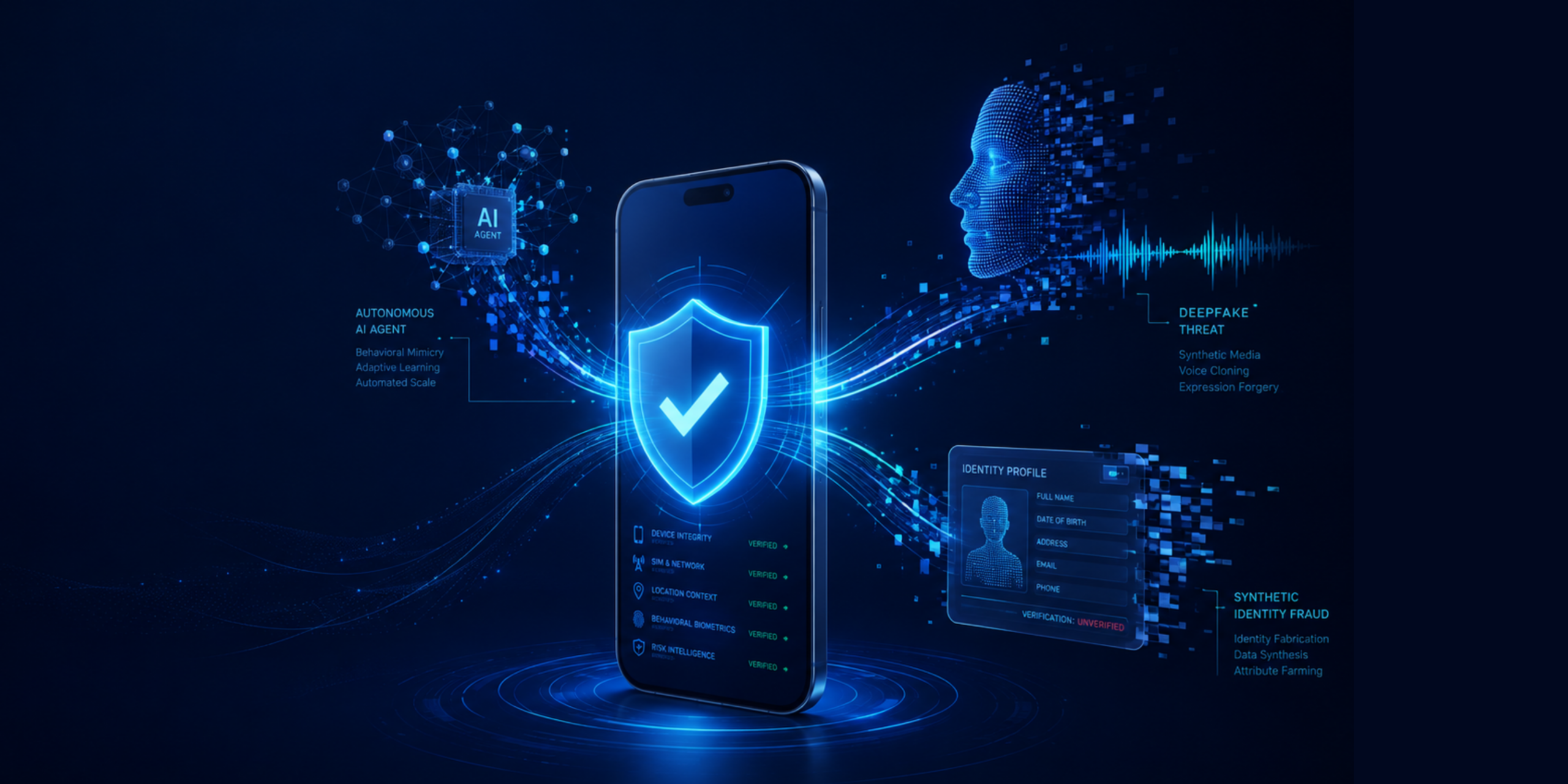
AI Is Attacking Enterprise Identity.
The Mobile Device Is How
Enterprises Fight Back.
Agentic AI
AI agents can streamline workflows and deliver real efficiency gains. But they also introduce a new attack surface that existing credential models cannot handle.
Deepfakes
Real-time face and voice synthesis now bypasses biometric liveness checks. These attacks are documented, and the tools are already consumer-grade.
Synthetic Identity
AI has made fabricating a convincing identity faster and cheaper than ever. Fraud losses are measured in the billions annually and growing
AI has introduced three distinct threat vectors to enterprise identity.
- AI has introduced three distinct threat vectors to enterprise identity.
Agentic AI fraud creates entirely new authorization risks as autonomous systems act on behalf of customers at machine speed. - Deepfakes have broken the foundational assumption of biometric verification: that a face or voice can be trusted.
- And synthetic identity fraud, long a feature of the threat landscape, has accelerated with generative AI, which can produce convincing fabricated identities at scale.
Each attack targets a different layer of enterprise verification. And each one is defeating traditional defenses, document checks, biometric liveness, credential-based authorization, faster than those defenses can adapt.
The question is not whether existing stacks can withstand these attacks. It is what kind of signal can. The answer is one that AI cannot fabricate, because it is grounded in the physical world: the mobile device and the authoritative data that surrounds it, whichform the foundation of mobile identity verification.
Wherever a customer journey begins, whether in a browser, app, kiosk, or AI agent, enterprise security ultimately runs through the mobile device.
The mobile device is the one element of the identity journey that simultaneously carries verified subscriber identity, real-time carrier and contextual signals, device-bound credentials, and tamper-evident hardware.
Real-time contextual signals include device fingerprint, SIM status, location, IP intelligence, account tenure, line type, porting history, and behavioral patterns that help confirm whether the journey the legitimate customer’s known phone, device, and profile.
No AI-generated identity has a phone. No deepfake can replicate a SIM history. No compromised agent can satisfy a passkey bound to a physical device
This is not a theoretical advantage. It is an architectural advantage, and it applies across every fraud scenario AI has introduced. It also directly supports account takeover prevention, mobilfraud prevention, and AI fraud prevention.
THREAT 01 —AGENTIC AI FRAUD
Agentic AI is a business imperative. It is also a new attack surface.
AI agents that act autonomously on behalf of customers are not a future consideration.They are already in production. Enterprises are deploying them to initiate payments, manage accounts, execute workflows, and handle complex multi-step processes at machine speed. The efficiency gains are real, and the competitive pressure to adopt agentic mode ls is growing across every sector.
The security challenge is equally real. Agentic systems require authorization, such as a session token, an API credential, a delegated permission set,and that authorization is typically granted once and then trusted continuously. That model works when a human is initiating every action. It breaks when the agent operates autonomously over extended periods, because the enterprise has no reliable mechanism to confirm that the customer who originally granted access is still in control of what is being done in their name.
The chain of authorization can break silently: a session is hijacked, a credential is compromised, an agent is manipulated into acting outside its intended scope. The system sees a valid token and executes. Static credentials cannot answer the question that matters at the moment it matters most: Is there a verified, consenting customer behind this action, right now?
Two layers of defense: verify the agent, then verify the customer
Zumigo operates at both levels. First, the agent’s session is verified in real time against the customer’s known phone, device, and contextual signals, including device fingerprint. If the device, SIM status, location, or IP deviates from the customer’s established profile, the action is flagged before it executes, regardless of whether the credential is technically valid.
Second, for critical actions, the customer is brought directly into the loop via an alert to their mobile device.
At that moment, Zumigo’s full signal stack activates: the phone receiving the alert is verified against the subscriber record, SIM and device status are confirmed in real time, and the customer acknowledges with a device -bound passkey.
That passkey serves as cryptographic proof, bound to their specific physical device, that they were present and consenting at that exact moment. A passkey cannot be phished, replicated, or operated remotely by an agent. It requires the customer to be there.
This delegated trust model scales across all journey types, whether human-initiated or fully AI-powered. The mobile device is the channel through which the customer is always reachable, always verifiable, and always capable of asserting control over actions taken in their name.
WHAT AI ENABLES
→ Autonomous agent action Operates on stolen credentials with no customer in the loop
→ Silent session hijack Authorization chain broken without the enterprise knowing
→ Credential sharing Tokens distributed across multiple devices or agents
→ High-velocity automated requests OTP and API abuse at machine speed
→ Long-horizon fraud Agent accumulates permissions and acts over extended periods
WHAT DEFEATS IT
→ Real-time agent verification Session checked against known phone, device and contextual signals for the customer
→ SIM, device and contextual consistency checks Changes to customer’s phone or device flagged since last authorization
→ Device proliferation detection Credential sharing across multiple devices surfaced within 30 days
→ OTP velocity monitoring Automated activity patterns identified and flagged in real time, with call forwarding check
→ Phone-based customer step-up Alert toverified device; passkey confirmation required for critical actions
THREAT 02 — DEEPFAKE-ASSISTED ACCOUNT TAKEOVER
AI can spoof a face. It cannot spoof a SIM.
DOCUMENTED INCIDENT
In early 2024, a finance employee at a multinational firm transferred $25 million after a video call in which every participant—including the CFO—was a deepfake. Biometric verification assumed the face belonged to the account holder. That assumption no longer holds
Real-time deepfake generation is now accessible via consumer tools. Liveness checks can be bypassed. Voice cloning works from minutes of audio. Biometric verification was designed as a single-signal trust anchor. When that signal is fabricated, the chain collapses because nothing underneath catches the failure.
Document verification carries the same structural weakness. A step-up authentication flow thatrelies on a document check or biometric selfie alone,without phone signals,can be exploited at the exact point where enterprises most need confidence. The attacker controls the one signal the system checks, and nothing else is asked.
Delegate the verification journey to the phone
A verification journey that begins on a desktop,where an attacker has full control of the session
environment, can be delegated to the customer’s mobile device, where that control ends.
The moment the journey moves to the phone, Zumigo’s full signal stack activates: silent network authentication confirms the SIM in use belongs to the registered subscriber without any customer action, as a form of mobile device authentication.
Real-time SIM swap detection catches the most common account takeover setup before verification completes. Device fingerprinting, IP intelligence, and real-time contextual signals confirm the session is consistent with the customer’s established profile.
An attacker running deepfake software on a spoofed session cannot simultaneously replicate a clean SIM history, a matching device fingerprint, and a consistent location profile. Each of these signals reflects the physical reality of the legitimate customer’s device. Together, they defeat a threat that biometrics alone cannot and strengthen account takeover prevention for ATO fraud scenarios.
WHAT AI ENABLES
→ Real-time deepfake video Biometric liveness check passed
→ AI-generated identity documents Document verification passed
→ SIM swap precursor Phone channel seized before verification attempt
→ Call forwarding active OTPs and alerts redirected away from legitimate customer
→ Spoofed desktop session Attacker controls the verification environment
WHAT DEFEATS IT
→ Silent network authentication SIM confirmed as belonging to registered subscriber, no friction
→ Real-time SIM swap detection Swap flagged within 0–30 days before verification completes
→ Call forwarding detection Active forwarding identified as high-risk at session time
→ Device fingerprinting and IP check Session context verified against the customer’s established profile
→ Desktop-to-phone delegation Journeystepped up to mobile, where phone signals cannot be spoofed
THREAT 03 — SYNTHETIC IDENTITY FRAUD
AI can fabricate an identity. It cannot fabricate a phone.
Synthetic identity fraud has always been the most patient form of financial crime. A fraudster assembles a plausible identity from real and fabricated PII, builds a credit history over months, then converts that manufactured trust into cash. What AI has changed is the cost and scale: generating consistent synthetic identities, complete with profile photos, employment history, and supporting documentation—
is now fast, cheap, and increasingly automated.
The attack exploits a structural gap in how most enterprise verification systems work.
Most checks are run against the PII itself: Is the document internally consistent? Does the address format match the zip code?
These checks are necessary but insufficient. They verify that a story is coherent. They cannot verify that the person behind it is real.
The defense: route the journey through the phone, then verify in layers
The first principle of defeating synthetic identity fraud is directing the customer journey through the mobile device using a mobile identity verification approach. A desktop session allows an attacker to control the environment entirely. A journey routed to the phone immediately activates a defense stack that a synthetic identity cannot satisfy.
The first layer is phone possession.
- Silent Network Authentication confirms that the SIM in use belongs to the registered subscriber without any customer interaction: no OTP, no redirect, no friction.
- For higher-assurance scenarios, device-bound passkeys provide a phishing-resistant, device-bound credential that cryptographically proves the customer is physically present with their registered device.
- Neither check can be passed by a fraudster who does not hold the real customer’s phone. A synthetic identity, by definition, has no real phone to present.
The second layer is carrier-validated PII.
- Once phone possession is established, Zumigo verifies that the identity submitted during onboarding matches what the carrier independently holds for that subscriber including name, address, account type, and activation history.
- This is not a self-reported check. The carrier record was established independently ofanything the applicant submits, and a synthetic identity assembled from fabricated or borrowed PII will not match it.
The third layer is multi-source corroboration.
- Zumigo cross-references the submitted identity against financial institution data and trusted third-party sources simultaneously.
- Each source is maintained independently. Each reflects a different dimension of a real person’s verifiable existence.
- A synthetic identity that survives the carrier check will fail when its PII cannot be corroborated across sources that have no reason to agree unless the person is real.
The phone also carries real-time contextual and behavioral signals that reinforce all three layers. A number activated last week on a disposable prepaid line, linked to multiple email addresses in the past month, with no prior carrier history, creates a risk profile that is invisible to a document check and immediately visible to phone intelligence. SIM, IMEI, account tenure, line type,porting history, location, IP, and device context together describe whether a device belongs to a person with an established life, or one created for a single fraudulent application.
WHAT AI ENABLES
→ Fabricated PII sets Internally consistent but unverifiable across independent sources
→ AI-generated documents Pass format and consistency checks
→ Synthetic credit histories Built slowly to appear legitimate
→ Disposable or new numbers No carrier history behind the claimed identity
→ Coordinated fraud rings Same infrastructure reused across multiple applications
WHAT DEFEATS IT
→ Journey routed to the phone Desktop session stepped up to mobile, activating the full defense stack
→ Phone possession via SNA and passkeys Silent Network Authentication and device-bound passkeys confirm physical presence before any PII check runs
→ Carrier-validated PII Submitted identity matched against the carrier’s independent subscriber record
→ Multi-source corroboration PII cross-referenced against financial institutions and trusted third parties simultaneously
→ Line intelligence signals SIM type, IMEI, tenure, porting history, and disposable number patterns assessed in real time
THE PRINCIPLE
One trust anchor. Every journey.
The three AI threats described here,agentic fraud, deepfakes, and synthetic identity, differ in their mechanics but share the same vulnerability. Each one exploits an enterprise verification system that checks what is presented, not what can be independently confirmed. Each one fails when the check is grounded in the physical reality of a mobile device.
A synthetic identity has no corroborating record across independent authoritative sources. A deepfake session cannot replicate a legitimate customer’s SIM history. A compromised agent cannot satisfy a passkey bound to the customer’s physical device. These are not incremental improvements to existing controls. They represent a fundamentally different class of verification, anchored in signals that exist in the real world and cannot be generated by AI.
Enterprise customer journeys will continue to originate a cross many channels: browsers, apps, kiosks, voice interfaces, and AI agents. The channel of origin matters less than where trust is ultimately grounded. When that anchor is the mobile device,with its carrier-verified subscriber identity, real-time contextual signals, and device-bound passkeys, and mobile device authentication,the journey is secure regardless of where it begins or what is initiating it.
ABOUT ZUMIGO
Zumigo is a digital identity intelligence company providing real-time identity verification, authentication, and fraud prevention signals to enterprises across financial services, insurance, telecommunications, and beyond. Drawing on a global network of mobile operators, trusted third-party data providers, and financial institutions, Zumigo’s platform delivers phone, device, email, and behavioral signals, including mobile device authentication and device fingerprinting,that help organizations verify identities, detect fraud, and protect customers across the full customer journey, without adding friction for legitimate users.
Q&A
- Question: What new identity threats has AI introduced, and why do traditional defenses struggle against them?
Short answer: AI has created three distinct threat vectors: agentic AI fraud, deepfakes, and synthetic identity fraud. Agentic AI fraud uses autonomous agents to act at machine speed with valid but misused credentials. Deepfakes use real-time face and voice synthesis tobypass biometric liveness checks. Synthetic identity fraud uses AI -generated identities at scale. Traditional controls, including document checks, biometric verification, and static credential-based authorization, focus on what the user or session presents. AI can now fabricate those signals convincingly, which means these controls are being defeated faster than they can adapt. - Question: Why is the mobile device an effective trust anchor that AI can’t fabricate?
Short answer: A mobile device carries signals rooted in physical reality and carrier infrastructure, including verified subscriber identity, SIM and device status, real-time contextual signals, device-bound passkeys, device fingerprint, location and IP consistency, and tamper-evident hardware. No AI-generated persona has a real phone with a consistent SIM history, and no deepfake can produce carrier-validated signals. Grounding verification in these phone-based signals provides a class of assurance that synthetic identities, spoofed sessions, and compromised agents cannot replicate. - Question: How does Zumigo protect against agentic AI fraud without disrupting legitimate automation?
Short answer: Zumigo applies two layers. First, it verifies the agent’s session in real time against the customer’s known phone and device parameters, including device fingerprint, SIM status, location, and IP. This allows Zumigo to flag anomalies even when the credential is technically valid. Second, for critical actions, Zumigo steps up to the customer’s verified phone. SIM and device status are confirmed, and the customer consents using a device-bound passkey that cannot be phished, shared, or operated by an agent. Supporting controls include device proliferation detection to expose credential sharing, OTP velocity monitoring to spot automated abuse, and SIM and device consistency checks over time. - Question: How does moving a desktop verification flow to the phone stop deepfake-assisted account takeover?
Short answer: Delegating verification to the customer’s phone activates stronger, non-spoofable signals. Silent Network Authentication confirms the SIM belongs to the registered subscriber with no friction. Real-time SIM swap detection and call forwarding detection catch takeover precursors before completion. Device fingerprinting and IP intelligence validate the session context. For high-risk steps, a device-bound passkeyproves the legitimate customer is physically present, using controls a deepfake cannot satisfy from a spoofed desktop session.
- Question: How does Zumigo detect and block synthetic identity fraud during onboarding?
Short answer: Zumigo layers defenses that synthetic identities cannot meet. First, phone possession is verified through Silent Network Authentication and, when needed, device-bound passkeys. This establishes real, physical presence before any PII check. Second,submitted identity data is matched against carrier records, including name, address, account type, and activation history, that exist independently of the applicant. Third, multi-source corroboration checks PII simultaneously against financial institutions and trusted third parties. Line intelligence, including SIM type, IMEI, tenure, porting history, and disposable number patterns, further exposes numbers created for fraud that document-only checks would miss.